Kai Ingemann Schnetler


|
Kai Ingemann Schnetler |
|
|
To new gastropods from the Baunekule facies in Faxe. They have been established by Pierre Lozouet in the paper: The Caenozoic Pickworthiidae of the European Atlantic Region (Mollusca, Gastropoda, Caenogastropoda) - Iberus, 42 (1): 1-54, 2024.
New paper treating the late Oligocene at Vilsund (Mors)
Schnetler, K.I., Madsen, H., Śliwińska, K.K.,
Heilmann-Clausen, C. & Ulleberg, K. 2024:
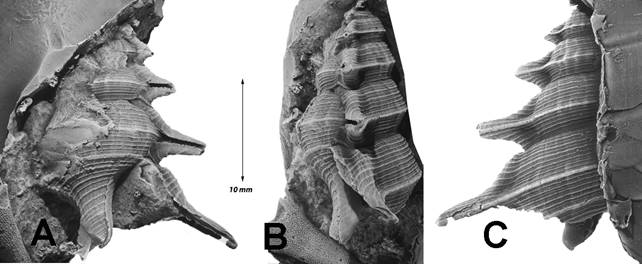
Cerithiopsis vilsundensis Schnetler et al., 2024
New book treating the fossils from the Oligocene of the Limfjorden area New book treating the Oligocene mica-clay and crab nodules has been published på 144 sider er udgivet. The book containes 144 pages in A4 with many illustrations and text in Danish and English.
The price is
249 DKK.
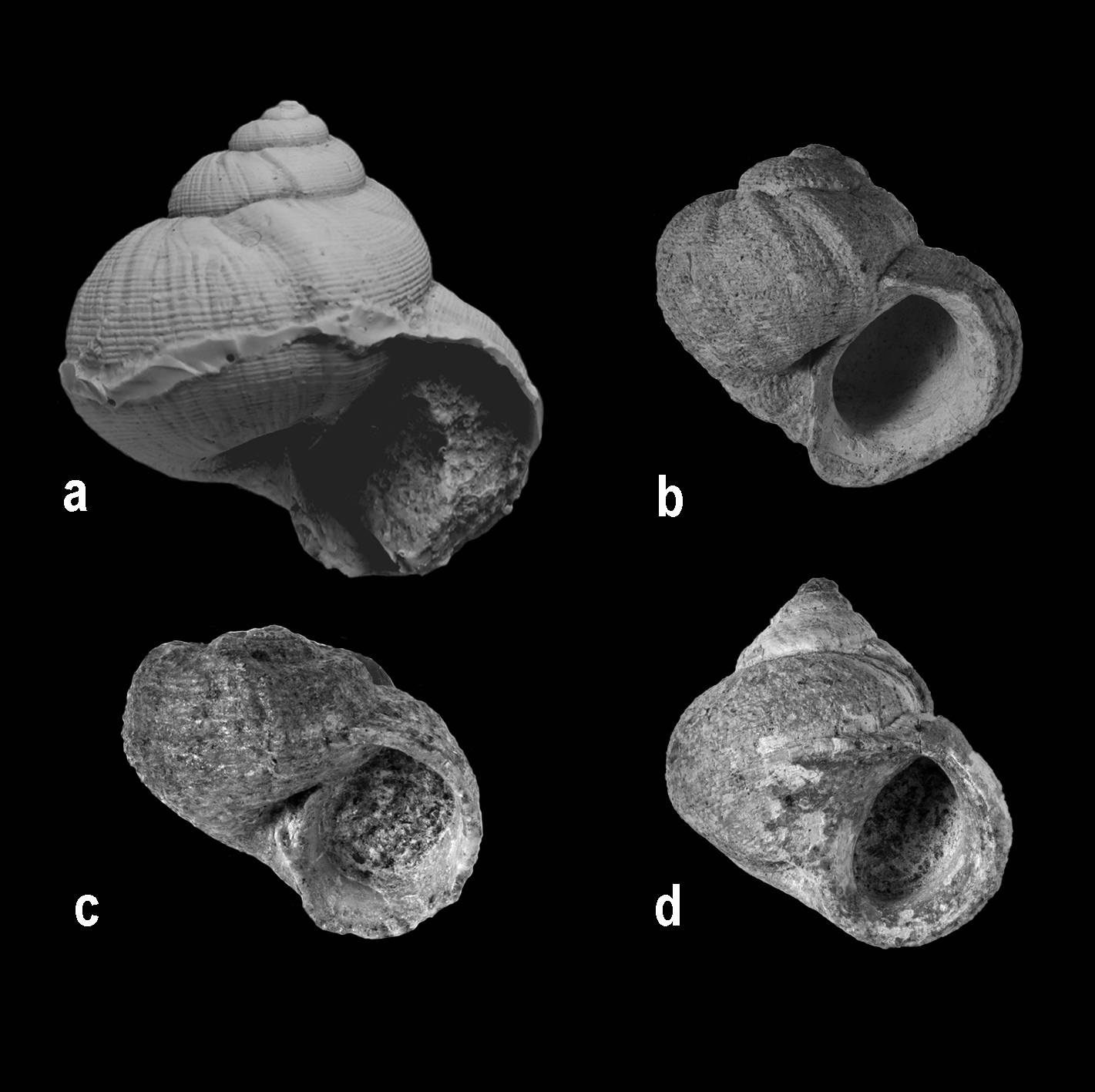
New gastropods from the Paleocene of Denmark and West Greenand The gastropod genus Vanikoropsis is predominantly known from the Cretaceous, but Rosenkrantz (1970) established a species from the Nuussuaq Peninsula in West Greenland. Kollmann & Peel (1984) recorded further two species of Vanikoropsis in the material, collected by Rosenkrantz, but they did not establish these as new. Peter Tang Mortensen collected in 2020 a single specimen of an unknown gastropod in a boulder of Kerteminde Mergel from the gravel-pit at Gundstrup on Funen. A study assigned the specimen to the a new species of the genus Vanikoropsis, a genus not previously recorded from Denmark. Schnetler & Nielsen established the new species and the two until now undescribed species from West Greenland. The species from Gundstrup is the youngest known representative of the genus Vanikoropsis. It was declared danekræ (DK 1133).
a. Vanikoropsis mortenseni Schnetler & Nielsen, 2021; b. Vanikoropsis (s.l.) skoui Rosenkrantz, 1970; c. Vanikoropsis (s.l.) jakobseni Schnetler & Nielsen, 2021; d. Vanikoropsis (s.l.) bashforthi Schnetler & Nielsen, 2021.
New monography on the molluscan fauna in boulders of Kerteminde Marl (Selandian,
Early Paleocene) in a gravel-pit at Gundstrup (Funen, Denmark)
The fauna contains 133
mollusc species, of which 27 are new.
Aporrhais gracilis
and
Drepanocheilus koeneni
Kangilioptera gundstrupensis and Quadrinervus
wienekei
Schnetler, K.I. & Nielsen, M.S. 2018:
A Palaeocene (Selandian) molluscan fauna from boulders of Kerteminde Marl in the
gravel-pit at Gundstrup, Fyn, Denmark.
Cainozoic
Research 18(1), pp. 3-81. June 2018.
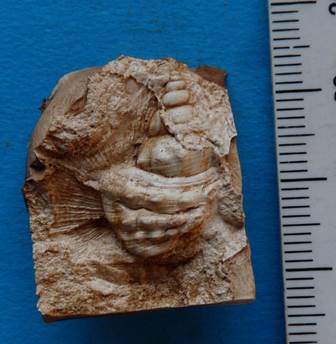
Spiniloma faxensis,
a unique gastropod species from corallian chalk at Faxe (Danian)
The specimen
was pictured in Damholt & Rasmussen (2010) and first presumed to be a Muricid.
However, further studies resulted in an assignment to the subfamily
Spinilomatinae of the family Spinilomatidae, which was distributed during the
Jurassic and Cretaceous.
The only known specimen is preserved as an external impression in corallian
chalk and a mould in silicone rubber shows the long spines and the fine spiral
ornament. The species was named
Spiniloma? faxensis
after the type locality Faxe quarry and was published April 2017 in Bulletin of
the Geological Society of Denmark (Dansk Geologisk Forening).
Damholt, T., Rasmusssen, A. &
Rasmussen, L. 2010:
Fossiler fra Faxe Kalkbrud. 2. oplag. Revideret udgave. Geomuseum Faxe. 48 pp.
Schnetler, K.I., & Milàn, J., 2017:
A new Cenozoic record of spinilomatine aporrhaids (Stromboidea, Caenogastropoda)
in the early Paleocene of Faxe, Denmark. The Catalogue of the gastropods from the Baunekule facies (nose-limestone)
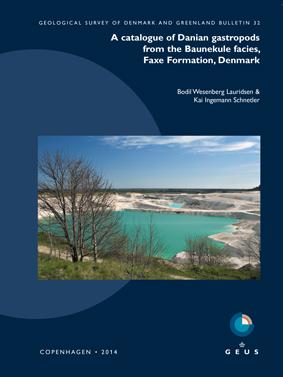
Lauridsen, B.W. & Schnetler, K.I. 2014. A catalogue of Danian gastropods from Baunekule facies. – Geological Survey of Denmark and Greenland Bulletin 32, 117 pp. Abstract
The
present catalogue of 194 gastropod taxa is based on the Danian collection of
gastropods from the Baunekule facies, Faxe Formation
in eastern Denmark.
The gastropod fauna is extremely rich and well preserved.
Most of the gastropods (106
species) are referred to genus level only, 9 morphotypes to even higher
taxonomical levels and 79 gastropods are referred to species level. The
gastropods are classified following Bouchet & Rocroi (2005) as 4 different
clades: Vetigastropoda (represented by 26 species and 10 superfamilies);
Caenogastropoda (represented by 142 species and 17 superfamilies);
Heterobranchia (represented by 23 species and 5 superfamilies) and
Opisthobranchia (represented by 1 species and 1 superfamily).
The
new species
Zaclys?
nuetzeli
n. sp. is introduced.
The Faxe
Formation is recognized as a cold-water coral ecosystem with interfingering
smaller bryozoan mounds. The Baunekule facies is found in the upper part of the
coral mound complex of the Faxe Formation, where it forms isolated lensoidal
bodies in the flanks of some of the coral mounds. It is characterized by a high
diversity invertebrate fauna set in weakly consolidated coral-dominated
floatstone to rudstone. The diagenesis of the Baunekule facies is of special
significance because a high proportion of the originally aragonite-shelled fauna
is preserved by recrystallization to calcite during early burial diagenesis.
Most of the gastropods are not known from other parts of the Faxe Fm. The fauna
is very important for evolutionary comparative studies of the fossil and modern
gastropods on cold-water coral mounds. Many of the genera were not known from
Danian strata before. No gastropod species found in the Baunekule facies are
known for certain to have passed the K/Pg boundary. The fauna is comparable to
gastropods found on modern cold-water coral mounds in the
The gastropod fauna from Baunekule facies is characterized by a very high
diversity of rather small millimeter sized gastropods having a preference for
hard substrate and with more than 63.9% belonging to the browsing carnivore
trophic group feeding mainly on sedentary animals. Surprisingly, the fauna
contains some common occurrence of typically warm water species. The fauna
consists mostly of Cenozoic genera and up to 87% of the species could be endemic
to the cold-water coral ecosystem of the Faxe Fm. The diverse and rather unusual
gastropod fauna from Baunekule facies is undoubtly linked to the evolution of
cold-water coral ecosystems. A full-text pdf can be downloaded from the website of GEUS on this link: http://www.geus.dk/UK/publications/geol-survey-dk-gl-bull/32/Pages/default.aspx
|

![Kan være et billede af tekst, der siger "LOZOUET: The Caenozoic Pickworthiidae of the European Atlantic Region 100 um B 50 μη Figure 22. Mareleptopoma? aliceae sp., Paleocene, Danian, Fakse Quarry. A, C-E: holotype [MGUH-34205 leg. coll. ISL, H= mm; B, F-H: paratype [MGUH-34206] coll. ISL, H= mm. grp by J.Le Renard. Figura 22, Mareleptopoma? aliceae sp. Paleoceno, Daniense, cantera Fakse. A, C-E: holotipo [MGUH-34205], rec. ISL, mm. F-H: paratipo [MGUH-34206] coll. ISL, H= 1,1 mm. Micrografias electrónicas de barrido por Le Renard."](https://scontent-cph2-1.xx.fbcdn.net/v/t39.30808-6/424786148_916818833568986_1526002344664655475_n.jpg?_nc_cat=109&ccb=1-7&_nc_sid=5f2048&_nc_ohc=_89i7cMyjKUAX98ZvE1&_nc_ht=scontent-cph2-1.xx&oh=00_AfAGtokl4FBnm9azghSNUtc-a6c5Y134l78Lb0Vg2qJ5YQ&oe=65F32A9D)
![Kan være et billede af tekst, der siger "LOZOUET: The Caenozoic Pickworthiidae of the European Atlantic Region B F 100 μm 100 μη Figure Sansonia schnetler Danian. Fakse Quarry. A-C, holotype [MGUH-34207]leg coll. ISL, H=1.4 D-F, H: paratype [MGUH-34208] leg oll. ISL, H= 3. mm. SEM micro- graphs I Renard. Figura Sansonia schnetleri Daniense. cantera Fakse. A-C, G: holotipo [MGUH-34207] ISL,Al mm; D-F paratipo MGUH-34208] ISL, H= mm. Micrografias electrónicas barrido por Renard."](https://scontent-cph2-1.xx.fbcdn.net/v/t39.30808-6/424687484_916818826902320_2378915336062579436_n.jpg?_nc_cat=110&ccb=1-7&_nc_sid=5f2048&_nc_ohc=HBbJCusW-XgAX-RuCHT&_nc_ht=scontent-cph2-1.xx&oh=00_AfAc5K9c18gFxEQTeCRV8h8ei6NHDp8I_tQ2sYCop-mFpA&oe=65F2D543)